

TL;DR:
- Premarital counseling primarily focuses on prevention, helping couples build communication skills and clarify expectations before marriage. It involves proactive discussions on key topics like finances, intimacy, and shared values, fostering a shared relationship vocabulary. Engaging fully in the process can strengthen bonds, improve conflict resolution, and promote long-term resilience.
Many engaged couples assume that marriage counseling before marriage is only for relationships already in trouble. That’s one of the most common and costly misconceptions about premarital counseling. The truth is, what is premarital counseling really about? It’s about prevention, not repair. It’s a structured, guided process that helps you and your partner build communication skills, clarify expectations, and develop the habits that healthy marriages actually run on. This guide walks you through what to expect, what happens in premarital counseling, and why it might be the most valuable thing you do before your wedding day.
Table of Contents
- What is marriage counseling before marriage?
- Why engaged couples should consider premarital counseling
- What to expect during premarital counseling sessions
- Is premarital counseling right for your relationship?
- How to prepare and make the most of premarital counseling
- A fresh perspective: Why premarital counseling is your relationship’s secret superpower
- Start your journey with Bergen County premarital counseling
- Frequently asked questions
Key Takeaways
| Point | Details |
|---|---|
| Premarital counseling defined | It prepares engaged couples proactively by focusing on communication, finances, conflict, and shared values. |
| Proactive relationship building | Counseling helps couples develop skills and align expectations before problems arise. |
| Session structure | Includes individual questions, joint exercises, and homework for lasting skill development. |
| Assessment of fit | Early red flags and readiness factors help couples decide if counseling is right for them. |
| Maximizing benefits | Openness, engagement, and viewing counseling as investment greatly improve outcomes. |
What is marriage counseling before marriage?
Pre-marriage counseling is a form of therapy designed specifically for engaged or seriously committed couples who want to enter marriage with a stronger foundation. It’s different from traditional marriage counseling in one fundamental way: it’s proactive, not reactive. You’re not coming in to fix a broken relationship. You’re coming in to build a better one.
Premarital counseling covers communication, emotional needs, conflict management, financial planning, intimacy, and shared values. These aren’t surface-level conversations. A skilled counselor guides you into discussions that most couples avoid until they become arguments.
One widely used tool in pre-marital counseling is the Prepare/Enrich assessment, a research-backed questionnaire that identifies your relationship strengths and areas that need attention. It gives both partners a clear, nonjudgmental snapshot of where they align and where they don’t. Think of it as a relationship checkup before the commitment becomes official.
What does premarital counseling consist of? Here’s a quick overview:
- Communication styles and how you handle disagreements
- Financial expectations, spending habits, and long-term money goals
- Intimacy, physical and emotional connection
- Family planning and parenting philosophy
- Roles, responsibilities, and shared household expectations
- Personal values, faith, and long-term life goals
For a broader look at how this compares to traditional therapy for couples, our marriage counseling guide explains the full spectrum of options available to couples at different stages.
Why engaged couples should consider premarital counseling
Most couples spend more time planning their wedding than preparing for their marriage. That’s not a criticism; it’s just how the culture works. But the wedding lasts one day. The marriage lasts a lifetime.

Premarital counseling helps couples actively build stronger communication patterns while the counselor guides the process. The key word is “actively.” You’re not sitting back and listening to advice. You’re practicing real skills in a safe environment, with a professional who can catch patterns you might not notice yourself.
One of the most underrated benefits of pre-marital counseling is what it does for sensitive topics. Money fights are one of the leading causes of divorce. So are mismatched expectations about children and careers. Premarital counseling facilitates candid conversations about finances, careers, and family planning, helping couples get on the same page before the wedding rather than years into the marriage.
“The goal of premarital counseling isn’t to find reasons the relationship shouldn’t work. It’s to give both partners the tools to make sure it does.”
Specific benefits of premarital counseling include:
- Developing a shared language for disagreements before they become destructive
- Reducing anxiety about major life transitions by discussing them openly in advance
- Strengthening emotional intimacy through guided vulnerability exercises
- Identifying unspoken assumptions about marriage roles before they cause resentment
- Building confidence as a couple, not just as two individuals who love each other
Pro Tip: If one partner is hesitant about counseling, reframe it together. You’re not going because something is wrong. You’re going because you take the relationship seriously enough to invest in it before it needs defending.
Explore the full benefits of premarital counseling to understand why couples who attend report higher relationship satisfaction in the first years of marriage.
What to expect during premarital counseling sessions
Understanding what happens in pre-marriage counseling takes away the anxiety of walking into the first session. Here’s how the process typically unfolds:
- Individual intake or questionnaire. Many counselors begin with separate sessions or assessments. Counselors ask tailored individual questions early to reduce defensiveness and understand each person’s background, family of origin, and personal expectations.
- Joint sessions with structured exercises. The bulk of pre-marital counseling happens together. Sessions include active listening exercises, conflict role-plays, and guided discussions on key topics.
- Homework and real-world practice. Most programs include role-plays, listening exercises, and homework to build practical communication skills outside the therapy room.
- Review and reinforcement. The final sessions often revisit areas of tension identified early on, giving couples a chance to measure their growth and address anything unresolved.
Premarital vs. traditional marriage counseling: How they compare
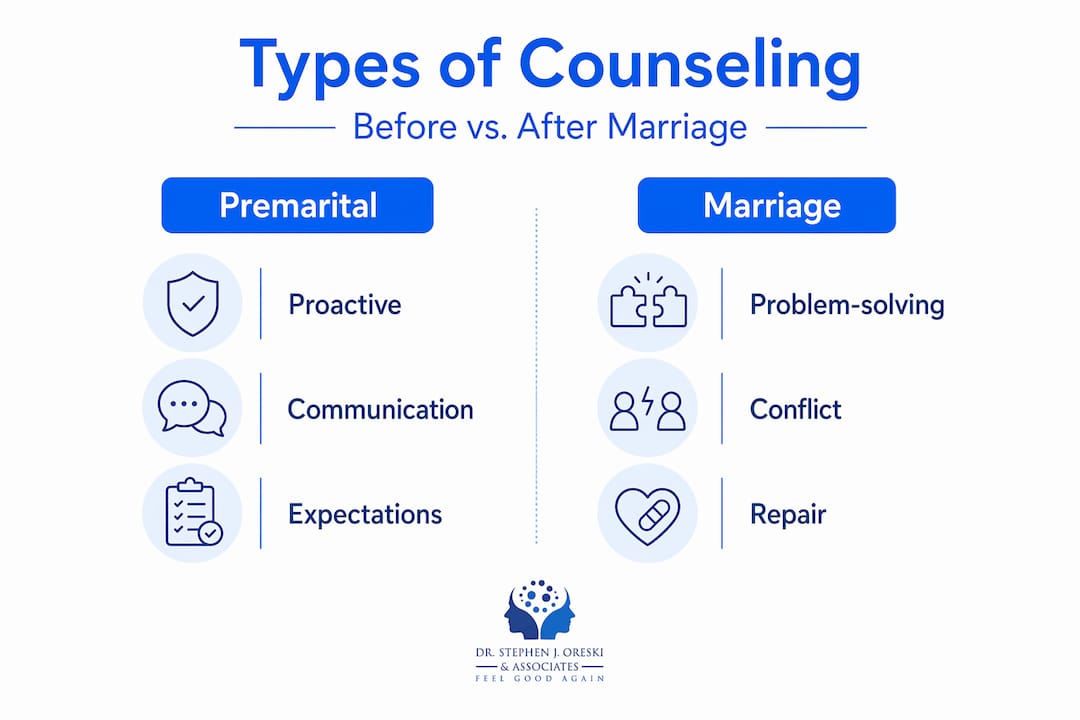
| Feature | Premarital counseling | Traditional marriage counseling |
|---|---|---|
| Timing | Before marriage | During or after problems arise |
| Focus | Prevention and skill-building | Problem-solving and repair |
| Emotional tone | Hopeful, forward-looking | Often high-stress, reactive |
| Goal | Build a strong foundation | Restore or improve a strained relationship |
| Typical participants | Engaged or committed couples | Married couples in conflict |
Pro Tip: Bring a list of topics you’ve been avoiding in your relationship to the first session. Not because you need to fight about them immediately, but because those are exactly the conversations the counselor is trained to guide you through safely.
You can explore session options and what to expect at premarital counseling sessions offered locally in Bergen County.
Is premarital counseling right for your relationship?
Short answer: yes, for almost every couple. Long answer: it depends on what you’re willing to do with it.
Pre-marital counseling is not just for couples experiencing problems. It works best as prevention. That said, it’s also a vital resource if you’re noticing early warning signs that something feels off. Early red flags like controlling behavior or power imbalances should prompt professional support before any lifelong commitment is made.
Counseling creates a safe environment to examine those dynamics without pressure, judgment, or the chaos of a real argument. It’s where you learn whether what you’re experiencing is a growth edge or a genuine deal-breaker.
Signs that premarital counseling is especially worth prioritizing:
- You avoid certain topics because they always escalate
- You and your partner have significantly different communication styles
- You’ve never had direct conversations about money, debt, or financial goals
- Your families of origin had very different conflict styles or relationship models
- You feel confident in your love but unsure about your long-term compatibility on practical matters
Pre-marriage counseling is not about doubting your relationship. It’s about knowing your relationship well enough to protect it.
How to prepare and make the most of premarital counseling
Walking in with the right mindset makes a measurable difference. Here’s how to set yourself up well:
- Go in with curiosity, not defensiveness. The goal is understanding each other, not winning.
- Complete all exercises and homework between sessions. The insights happen outside the room as much as inside it.
- Be honest, even when it’s uncomfortable. A counselor can only work with what you bring to the table.
- Use the sessions to build habits, not just solve problems. The communication patterns you develop now will carry you through years of challenges.
Premarital counseling establishes a helpful pattern of seeking guidance during life transitions, which prevents years of disconnection from building up unnoticed.
Pro Tip: Treat premarital counseling like strength training for your relationship. You don’t wait until you’re injured to go to the gym. You go to build the capacity to handle what’s coming.
The premarital counseling benefits are strongest for couples who engage fully, not passively.
A fresh perspective: Why premarital counseling is your relationship’s secret superpower
Here’s what most articles on this topic miss entirely. Premarital counseling isn’t just about preventing divorce or resolving conflicts before they happen. It does something far more valuable: it gives you a shared language for your relationship.
Most couples enter marriage with entirely separate emotional vocabularies. You each learned how to handle conflict, express love, and navigate stress in completely different households. Without deliberate work, you spend the first years of marriage essentially translating for each other, often getting it wrong.
Premarital counseling builds that shared vocabulary before the misunderstandings become entrenched. It creates a “relationship toolkit” that both partners understand and can use. And that toolkit doesn’t just help when things are hard. It deepens connection when things are good.
The other thing conventional wisdom gets wrong is framing marriage as a destination. “Get through the wedding, figure it out as you go.” Premarital counseling reframes marriage as a practice, something you actively tend to. Couples who go in with that mindset don’t just have smoother early years. They’re more resilient when life inevitably throws real challenges at them, job loss, illness, parenting stress, grief.
The premarital counseling benefits extend far beyond the honeymoon phase. They compound over time, the same way good habits do.
Start your journey with Bergen County premarital counseling
If this guide has clarified what marriage counseling before marriage actually looks like, the next step is finding the right support to make it real for your relationship. Dr. Stephen Oreski and his team at Bergen County Therapist offer personalized premarital counseling in Bergen County tailored to where you and your partner actually are, not a generic program designed for the average couple.
You can begin therapy with experts through a free initial consultation, where you’ll discuss your goals, concerns, and what you want your marriage to look like. Whether you’re looking to strengthen communication, navigate a sensitive topic, or simply start your marriage with confidence, the team is equipped to meet you there. The benefits of premarital counseling are clearest when you work with therapists who understand your community and your context.
Frequently asked questions
What topics are typically covered in premarital counseling?
Premarital counseling covers communication patterns, emotional needs, conflict management, financial expectations, intimacy, and shared long-term goals to fully prepare couples for married life together.
How is premarital counseling different from marriage counseling?
Marriage counseling is usually sought when difficulties already exist, while premarital counseling is preventative, focused on building skills and alignment before problems have a chance to take root.
When should couples start premarital counseling?
Couples are encouraged to access sessions before making a formal commitment rather than waiting for problems to surface, making early engagement the most effective approach.
What if we discover serious issues during premarital counseling?
If signs of controlling behavior or abuse emerge, step back and prioritize professional support immediately, your safety and well-being matter far more than any wedding timeline.
How can we prepare to get the most from premarital counseling?
Approach every session with openness, complete all assigned exercises, and view counseling as establishing a lasting pattern of growth and guidance rather than a one-time fix.