

- Codependency involves organizing your identity around a partner’s needs and moods at the expense of yourself.
- Recovery requires recognizing patterns, rebuilding self-awareness, and setting healthy boundaries with professional support.
Codependency is defined as a pattern where one person excessively organizes their sense of self around another, sacrificing their own needs, emotions, and identity to manage a partner’s life. This is not the same as being deeply in love or naturally supportive. A codependent relationship is one where your emotional stability depends almost entirely on your partner’s moods, choices, and approval. Codependency is not a formal DSM-5 diagnosis, but clinicians use the term widely to describe maladaptive relationship dynamics that cause real, lasting harm.
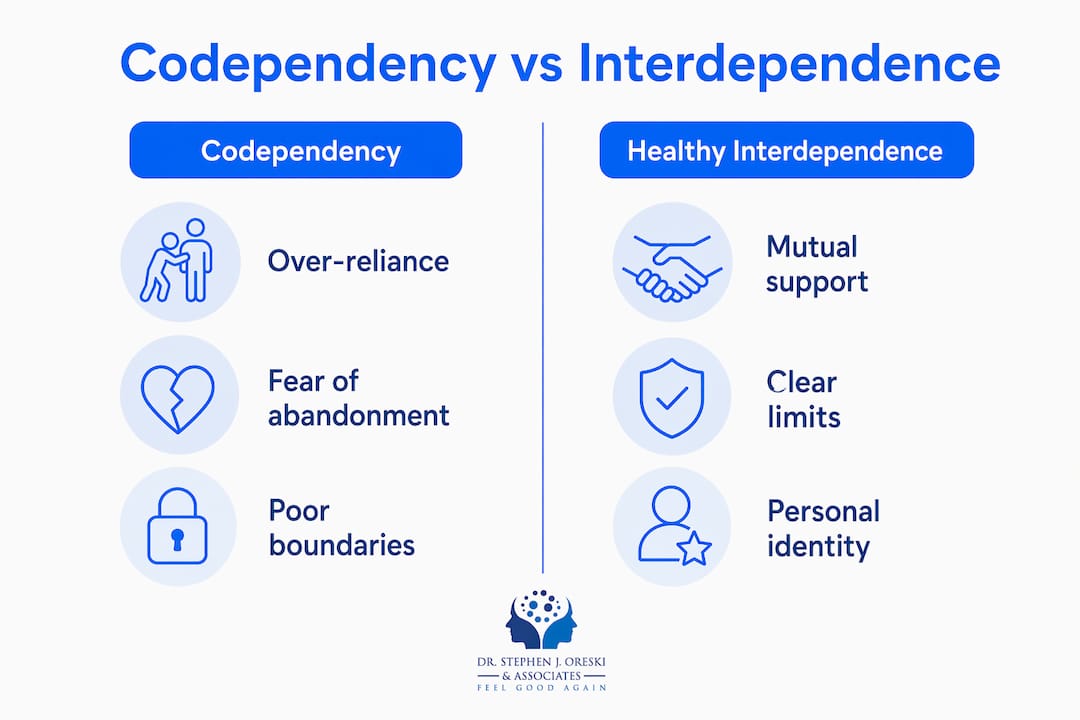
What does codependency look like in a relationship?
Codependency shows up in the quiet, daily grind of a relationship, not in dramatic blowups. It looks like compulsive caretaking, constant mood scanning, and a relentless effort to manage your partner’s emotional state as if it were a full-time job. Most people living this pattern do not recognize it as a problem. They call it love, loyalty, or just “being there” for someone.
The clearest signs of a codependent relationship include:
- Chronic self-sacrifice. You consistently put your partner’s needs first, even when it costs you your health, time, or happiness.
- Fear of abandonment. You stay in relationships that feel wrong because the thought of being alone is unbearable.
- Mood tracking. You scan your partner’s emotional state the moment they walk in the room and adjust your behavior accordingly.
- Inability to set limits. You say yes when you mean no, and feel guilty or anxious when you try to hold a boundary.
- Enabling behavior. You cover for a partner’s problems, make excuses for them, or fix their messes to avoid conflict.
- Emotional suppression. You hide your own feelings to keep the peace or to avoid burdening your partner.
- Identity loss. Your hobbies, friendships, and goals have slowly disappeared because the relationship consumes everything.
The pursuer-distancer dynamic is one of the most painful patterns in codependent relationships. One partner constantly seeks closeness and reassurance while the other withdraws. This creates a cycle where the more one person pursues, the more the other pulls away, and both feel increasingly trapped.
Pro Tip: If you notice that your mood rises and falls entirely with your partner’s, that is a signal worth paying attention to. Emotional regulation that depends on another person is a core feature of codependent behavior.

How does codependency differ from healthy interdependence?
The opposite of codependency is not independence. It is interdependence, where two people support each other while each maintains a clear sense of who they are. That distinction matters because many people confuse deep attachment with codependency, or mistake codependency for love.
The table below clarifies the key differences between codependency, healthy interdependence, and Dependent Personality Disorder (DPD).
| Feature | Codependency | Healthy Interdependence | Dependent Personality Disorder |
|---|---|---|---|
| Identity | Merged with partner | Separate but connected | Relies on others to define self |
| Motivation | Control through caretaking | Mutual care by choice | Seeks others to manage their life |
| Boundaries | Weak or absent | Clear and respected | Avoids responsibility |
| Emotional regulation | Tied to partner’s state | Self-regulated with support | Fears being alone |
| Clinical status | Not a DSM-5 diagnosis | Not a disorder | Formal DSM-5 diagnosis |
Only 14.5% of people who identify as codependent meet the criteria for Dependent Personality Disorder. That number shows these are genuinely distinct issues. Codependent people get satisfaction from managing others’ lives. People with DPD want others to manage their lives for them. The direction of control is completely reversed.
Healthy relationships require clear personal limits and mutual care without either partner losing their individual identity. That is the standard codependency falls short of.
What psychological patterns drive codependent behavior?
Codependency is an attachment strategy formed in unstable or unpredictable environments, often in childhood. When a person grows up in a home where love felt conditional or where a caregiver’s moods were volatile, they learn to hyper-focus on others as a survival skill. That skill becomes a problem when it carries into adult relationships.
These behaviors are not character flaws. They are protective parts, adaptive responses that once served a real purpose. Understanding that reframes self-blame as self-compassion, the first real step toward change.
Common emotional triggers in codependent patterns include:
- Anxiety when a partner seems distant or upset, even without a clear reason
- Guilt when prioritizing your own needs, even in small ways
- Identity loss when the relationship ends or shifts, because the self was built around the other person
- Resentment that builds quietly beneath the surface of constant giving
Codependency often lives in the ordinary, not in crises. It is the person who cannot eat until they know their partner is okay. It is the one who rehearses conversations for hours to avoid upsetting someone. It is a daily experience of hypervigilance, not a dramatic event.
Pro Tip: Ask yourself: “Would I make this choice if I were not afraid of my partner’s reaction?” If the answer is no, you may be operating from fear rather than genuine care.
How can you begin to heal codependent patterns?
Recovery from codependency is possible, and it follows a clear path. Healing means shifting from compulsive caretaking to caring by choice, and rebuilding a relationship with yourself that does not depend on your partner’s approval.
- Name the pattern. Recognize specific behaviors, such as mood tracking or saying “yes” when you mean “no,” without judging yourself for them.
- Build self-awareness. Notice what you feel before you act. Pause between the impulse to fix and the action itself.
- Practice distress tolerance. Let your partner experience their own emotions without immediately stepping in to manage them. This is uncomfortable at first and gets easier with practice.
- Rebuild your identity. Reintroduce activities, friendships, and goals that belong to you alone.
- Seek professional support. A therapist trained in attachment and relational dynamics can help you untangle patterns that are difficult to see from the inside.
Healthy limits are not walls. They are the structure that makes genuine closeness possible. Without them, what looks like love is often fear in disguise.
Key Takeaways
Codependency is a learned attachment pattern, not a personal failing, and recognizing it is the first step toward building relationships grounded in genuine choice rather than fear.
| Point | Details |
|---|---|
| Core definition | Codependency means organizing your identity and emotions around a partner’s needs and moods. |
| Daily signs | Mood tracking, chronic self-sacrifice, and enabling behavior are the most common indicators. |
| Not the same as DPD | Only 14.5% of codependent people meet DPD criteria; the two patterns operate in opposite directions. |
| Root cause | Codependency is an attachment strategy formed in unstable environments, not a character flaw. |
| Path to healing | Recovery requires distress tolerance, identity rebuilding, and shifting from compulsive to chosen care. |
What I have learned working with codependent relationships
After years of working with couples and individuals, what strikes me most about codependency is how much intelligence it contains. The person who has spent years reading their partner’s moods, anticipating needs, and smoothing over conflict has developed a genuinely sophisticated relational skill set. The problem is not the skill. The problem is that it was built for survival, not for love.
What I see most often is not dramatic dysfunction. It is quite exhausting. People who have forgotten what they actually want because they have spent so long focused on what their partner needs. People who feel guilty for having a bad day because their partner is having a worse one.
The good news is that these patterns are not permanent. The same attunement that made someone hypervigilant can, with the right support, become genuine empathy. The same capacity for care that drove compulsive caretaking can become real generosity when it comes from choice rather than fear. I have watched people rebuild a sense of self they thought was gone for good. That kind of recovery is not just possible. It is more common than most people expect.
— Dr Stephen Oreski LCSW
Therapy support for codependency recovery
Recognizing codependent patterns in yourself or your relationship is meaningful work. Taking the next step with professional support makes that work faster and more lasting.
At Bergencountytherapist, Dr. Stephen Oreski and his team offer relationship counseling designed to address the specific dynamics that drive codependency, including attachment wounds, boundary work, and identity rebuilding. Sessions are available in person and online, making support accessible regardless of your schedule. If you are ready to understand what is driving your relationship patterns and build something healthier, a free consultation is the place to start. You can also explore psychotherapy options to find the approach that best fits your situation.
FAQ
What does it mean to be codependent on someone?
Being codependent on someone means your emotional stability, self-worth, and daily decisions revolve around that person’s moods and needs. Your sense of identity becomes so tied to them that you lose track of your own feelings and goals.
What are the clearest signs of codependency in a relationship?
The clearest signs include chronic self-sacrifice, fear of abandonment, compulsive caretaking, inability to set limits, and emotional suppression. Mood tracking, where you constantly monitor your partner’s emotional state and adjust your behavior accordingly, is one of the most telling indicators.
Is codependency the same as dependent personality disorder?
No. Only 14.5% of people who identify as codependent meet the criteria for Dependent Personality Disorder. Codependent people seek control through managing others, while people with DPD want others to manage their lives for them.
Can a codependent relationship become healthy?
Yes. Recovery involves building self-awareness, practicing distress tolerance, rebuilding personal identity, and shifting from compulsive caretaking to care by genuine choice. Therapy significantly accelerates this process.
What is the healthiest opposite of a codependent relationship?
The healthiest opposite is interdependence, where both partners maintain separate identities, regulate their own emotions, and support each other from a place of choice rather than fear or obligation.