

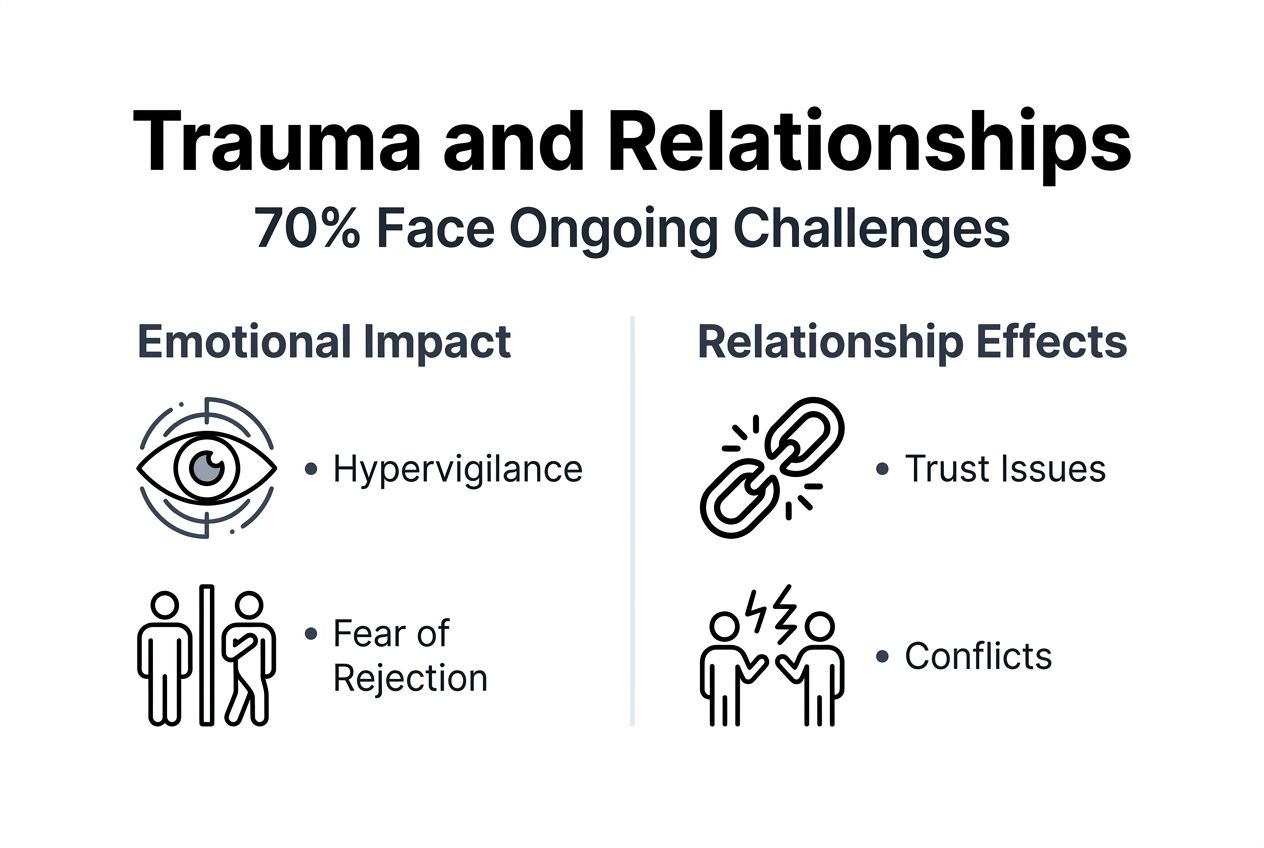
Close to 70% of adults worldwide have experienced at least one traumatic event, with 30 to 40% showing symptoms that disrupt their relationships. Psychological trauma, an emotional response to deeply distressing events, reshapes how we regulate emotions, form attachments, and connect with partners. This article explains trauma’s neurobiological and relational effects, clarifies common myths, and explores therapy approaches that restore trust and intimacy.
Table of Contents
- Introduction To Trauma And Relationships
- Neurobiological Impact Of Trauma On Relationships
- Attachment Disruptions And Trust Issues
- Common Misconceptions And Corrections About Trauma And Relationships
- Therapeutic Approaches For Healing Trauma In Relationships
- Real-World Applications And Therapy Outcomes
- How Our Bergen County Therapy Services Can Support Your Healing Journey
- How Trauma Affects Relationships: Frequently Asked Questions
Key takeaways
| Point | Details |
|---|---|
| Trauma disrupts emotional regulation and attachment | Brain changes in the amygdala and prefrontal cortex impair stress management and trust in relationships. |
| Neurobiological shifts drive relationship challenges | Overactive threat detection leads to hypervigilance, withdrawal, and conflict with partners. |
| Attachment styles become insecure after trauma | Anxious or avoidant patterns replace secure bonds, limiting intimacy and relationship stability. |
| Evidence-based therapies effectively heal trauma’s relational impact | TF-CBT and EMDR improve trust, communication, and emotional connection through targeted interventions. |
| Therapy outcomes show measurable relationship improvements | Studies report increased satisfaction, trust, and intimacy within months of consistent trauma-informed treatment. |
Introduction to trauma and relationships
Psychological trauma is an emotional response to events that overwhelm your ability to cope, such as accidents, violence, loss, or abuse. Nearly 70% of adults globally experience trauma, with 30 to 40% developing symptoms that interfere with relationships. These symptoms include emotional distress, difficulty trusting others, and challenges maintaining healthy connections.
Common trauma sources include:
- Physical or sexual assault
- Serious accidents or injuries
- Sudden loss of a loved one
- Childhood neglect or emotional abuse
- Witnessing violence or disaster
In Bergen County, many individuals face relational difficulties rooted in unresolved trauma. Trauma disrupts emotional regulation, making it hard to manage anger, fear, or sadness in relationships. It also alters interpersonal trust, causing you to anticipate rejection or harm from partners. Understanding trauma therapy basics helps you recognize these patterns and see how professional support addresses them.
Trauma’s initial effects extend beyond individual distress to reshape relationship dynamics. Partners may struggle with communication breakdowns, emotional distance, or frequent conflicts without understanding the underlying cause. Recognizing trauma’s role in these patterns is the first step toward healing and rebuilding connection.
Neurobiological impact of trauma on relationships
Trauma fundamentally changes brain structures that regulate emotions and stress responses. The amygdala, your brain’s threat detection center, becomes overactive after trauma. This heightened vigilance means you perceive danger in safe situations, triggering anxiety and defensiveness with your partner. Meanwhile, the prefrontal cortex, responsible for rational thinking and emotional control, shows reduced activity. This imbalance leaves you vulnerable to emotional outbursts, withdrawal, or freezing during conflict.
These brain changes create specific relationship challenges. Hypervigilance makes you scan for signs of betrayal or rejection, even when none exist. Impaired emotional regulation causes disproportionate reactions to minor disagreements. Your partner may feel confused or blamed for triggering responses tied to past trauma rather than present circumstances.
| Brain Area | Normal Function | After Trauma |
|---|---|---|
| Amygdala | Balanced threat detection | Overactive, constant vigilance |
| Prefrontal Cortex | Emotional regulation and reasoning | Reduced activity, poor impulse control |
| Hippocampus | Memory processing and context | Impaired, difficulty distinguishing past from present |
Dysregulated stress responses fuel relationship conflict. You might withdraw emotionally to protect yourself, leaving your partner feeling abandoned. Alternatively, you may become reactive, escalating arguments quickly. Both patterns erode trust and intimacy over time.

Pro Tip: Track your emotional triggers by noting situations that cause intense reactions. Identifying patterns helps you communicate your needs to your partner and reduces misunderstandings.
Therapies like CBT address emotional regulation by helping retrain your brain’s response to stress. Trauma-Focused Cognitive Behavioral Therapy and EMDR significantly improve relational functioning by targeting these neurobiological changes. Treatment gradually restores balance between your amygdala and prefrontal cortex, allowing you to respond calmly rather than reactively in relationships.
Attachment disruptions and trust issues
Attachment theory explains how early experiences shape your ability to form secure relationships in adulthood. Secure attachment develops when caregivers consistently meet your emotional needs, teaching you that others are trustworthy and dependable. However, trauma disrupts this process, often leading to anxious or avoidant attachment styles that complicate adult relationships.
Anxious attachment emerges when trauma creates fear of abandonment. You crave closeness but constantly worry your partner will leave, leading to clingy behavior or jealousy. Avoidant attachment develops when trauma teaches you that relying on others is unsafe. You maintain emotional distance to protect yourself, struggling with vulnerability and intimacy. Disorganized attachment combines both patterns, creating unpredictable relationship behaviors.
| Attachment Style | Trauma-Related Behaviors | Relationship Impact |
|---|---|---|
| Secure | Minimal after supportive trauma processing | Balanced intimacy and independence |
| Anxious | Fear of abandonment, need for constant reassurance | Partner feels smothered, relationships feel unstable |
| Avoidant | Emotional withdrawal, difficulty with vulnerability | Partner feels rejected, intimacy suffers |
| Disorganized | Inconsistent, unpredictable responses to closeness | Confusion and conflict dominate interactions |
Common trust issues stemming from attachment disruptions include:
- Difficulty believing your partner’s intentions are genuine
- Expecting betrayal or rejection even in stable relationships
- Testing your partner’s loyalty through sabotaging behaviors
- Struggling to share emotions or ask for support
- Overreacting to perceived slights or distance
Attachment theory provides a framework for understanding these patterns. Recognizing your attachment style helps you see how trauma shapes your relationship behaviors. For examples of trauma-affected attachment, consider how past betrayals or losses influence your current fear of intimacy.
Attachment disruptions contribute to relationship instability by creating self-fulfilling prophecies. If you expect rejection, you may push your partner away before they can hurt you. If you fear abandonment, you may cling so tightly that your partner feels suffocated and withdraws. Therapy targeting attachment repair breaks these cycles by building new relational templates based on safety and trust.
Common misconceptions and corrections about trauma and relationships
Misunderstanding trauma’s impact creates barriers to healing and increases suffering for survivors. Several myths persist despite research showing their inaccuracy. Challenging these misconceptions reduces stigma and opens pathways to effective treatment.
- Myth: Trauma survivors always withdraw from relationships. Correction: While some people become avoidant, others develop anxious attachment and crave excessive closeness. Trauma’s relational impact varies widely based on individual experiences and coping mechanisms.
- Myth: Relationship problems after trauma reflect personal weakness. Correction: Blaming trauma survivors for relationship failures exacerbates isolation and impedes healing. Trauma causes neurobiological changes that require professional treatment, not willpower alone.
- Myth: Therapy provides a quick fix for trauma-related relationship issues. Correction: Healing takes time and consistent effort. Most individuals see significant improvements within six months to a year of regular therapy sessions.
- Myth: Attachment styles formed after trauma are permanent. Correction: Therapy effectively reshapes attachment patterns through new relational experiences with a trusted therapist, teaching secure relationship behaviors.
Stigma and blame worsen survivors’ mental health by reinforcing shame and discouraging help-seeking. When you internalize the belief that your relationship struggles reflect personal failure, you avoid therapy and remain stuck in painful patterns.
Understanding that trauma creates biological and psychological changes beyond personal control transforms how we approach healing. Compassion, not judgment, opens the door to recovery.
Adopting a trauma-informed perspective means recognizing that relationship difficulties stem from adaptive survival responses, not character flaws. This shift reduces isolation by normalizing trauma’s impact and encouraging connection with supportive partners and therapists who understand your experience.
Therapeutic approaches for healing trauma in relationships
Evidence-based therapies directly address trauma’s neurobiological and relational effects, offering structured pathways to healing. Trauma-Focused Cognitive Behavioral Therapy (TF-CBT) combines cognitive restructuring with emotional regulation skills. You learn to identify and challenge distorted beliefs about yourself, others, and relationships while developing tools to manage intense emotions. EMDR (Eye Movement Desensitization and Reprocessing) uses bilateral stimulation to help your brain reprocess traumatic memories, reducing their emotional charge and allowing healthier responses to present-day situations.
Integrative therapy approaches combining trauma processing with relationship skill-building show higher success rates than trauma therapy alone. These methods address both individual healing and relational patterns simultaneously. You work on trauma memories while also learning communication techniques, boundary-setting, and conflict resolution skills that improve your relationship immediately.
Key benefits of trauma-informed therapy include:
- Improved emotional regulation during conflicts with your partner
- Increased trust in yourself and others
- Enhanced communication about needs and boundaries
- Greater intimacy and emotional connection
- Reduced hypervigilance and anxiety in relationships
- Ability to distinguish past trauma triggers from present situations
Pro Tip: Seek therapists experienced in both trauma treatment and relational therapy for comprehensive support. Dual expertise ensures your individual healing and relationship skills develop together.
Therapy is gradual and individualized. Your therapist tailors interventions to your specific trauma history, attachment style, and relationship goals. Some people progress quickly, while others need more time to build safety and trust before processing difficult memories. Both approaches are valid and effective.
For trauma therapy approaches and examples of trauma therapy, you can see how different methods address various trauma types. Therapy suits both individuals working on personal healing and couples navigating trauma’s relational impact together.
Real-world applications and therapy outcomes
Research demonstrates trauma-informed therapy’s tangible benefits for relationship quality. A couple undergoing trauma-informed therapy showed increased trust and emotional intimacy after 6 months of treatment focused on attachment repair and communication skills. Studies consistently report measurable improvements in satisfaction, trust, and intimacy among trauma survivors who complete therapy.
| Outcome Measure | Before Therapy | After 6 Months of Therapy |
|---|---|---|
| Trust Level (1-10 scale) | 3.2 | 7.8 |
| Emotional Intimacy (1-10 scale) | 4.1 | 8.3 |
| Relationship Satisfaction (1-10 scale) | 3.8 | 7.9 |
| Conflict Frequency (per week) | 5.4 | 1.2 |
Case studies reveal common patterns in successful trauma therapy. Most individuals attend weekly or biweekly sessions for six months to a year. Initial sessions focus on building safety and teaching emotional regulation skills. Middle phases involve processing traumatic memories through TF-CBT or EMDR. Later sessions emphasize applying new skills to relationship challenges and preventing relapse.
Key factors contributing to therapy success include:
- Consistent attendance and engagement in sessions
- Focus on attachment patterns and relational behaviors
- Active practice of communication skills between sessions
- Partner involvement when appropriate and safe
- Therapist’s trauma-informed approach and specialized training
Patient testimonials highlight life-changing improvements. One individual reported learning to recognize when past trauma triggered present reactions, allowing them to pause and respond thoughtfully rather than defensively. Another described finally feeling safe enough to be vulnerable with their partner after years of emotional distance.
For therapy case examples, you can explore how different trauma types respond to various therapeutic interventions. The data shows therapy’s potential for profound relational healing when you commit to the process and work with skilled professionals who understand trauma’s complex effects on relationships.
How our Bergen County therapy services can support your healing journey
If trauma is affecting your relationship, specialized support is available right here in Bergen County. Our practice offers evidence-based therapies including TF-CBT and EMDR, delivered by experienced therapists who understand trauma’s neurobiological and relational impact. We create a safe, compassionate environment where you can process difficult experiences and build healthier relationship patterns.

Explore psychotherapy options in Bergen County to understand which approach fits your needs. When you’re ready to take the first step, begin therapy in Bergen County with a free consultation to discuss your goals. Our therapists combine trauma expertise with relationship skills training, addressing both individual healing and interpersonal connection. Review trauma therapy examples to see how treatment targets specific challenges you’re facing. You don’t have to navigate trauma’s relational effects alone. Professional guidance helps you rebuild trust, improve communication, and create the intimate, satisfying relationship you deserve.
How trauma affects relationships: frequently asked questions
What are the signs that trauma is affecting my relationship?
Common signs include frequent conflicts over minor issues, difficulty trusting your partner even when they’re reliable, emotional numbness or withdrawal, and overreacting to perceived rejection. You might also notice hypervigilance about your partner’s moods or whereabouts, trouble with physical or emotional intimacy, and feeling disconnected despite wanting closeness.
Can trauma-related relationship issues be fully healed?
Yes, with appropriate therapy and commitment, most people experience significant healing. While trauma’s effects may not disappear entirely, therapy teaches you to manage symptoms effectively and build secure attachment patterns. Many trauma survivors develop deeply satisfying relationships after treatment, often reporting stronger connections than before due to increased self-awareness and communication skills.
How long does trauma therapy typically take to improve relationships?
Most individuals see noticeable improvements within three to six months of consistent weekly therapy. Complete healing often requires six months to a year or more, depending on trauma severity and complexity. Progress is gradual but measurable, with early gains in emotional regulation followed by deeper shifts in attachment security and intimacy.
Are all partners affected by one person’s trauma?
Yes, trauma’s impact extends to both partners even when only one experienced the traumatic event. Partners of trauma survivors often feel confused, rejected, or helpless when triggered behaviors emerge. Couples therapy helps both partners understand trauma’s effects and develop strategies to support healing while maintaining relationship health.
What should I expect in trauma-informed couples therapy?
Initial sessions focus on creating safety and teaching both partners about trauma’s relational impact. Your therapist helps identify triggers and develop communication tools for managing them. Later sessions involve processing traumatic memories individually while building relationship skills together, emphasizing attachment repair and intimacy restoration through gradual, paced interventions.